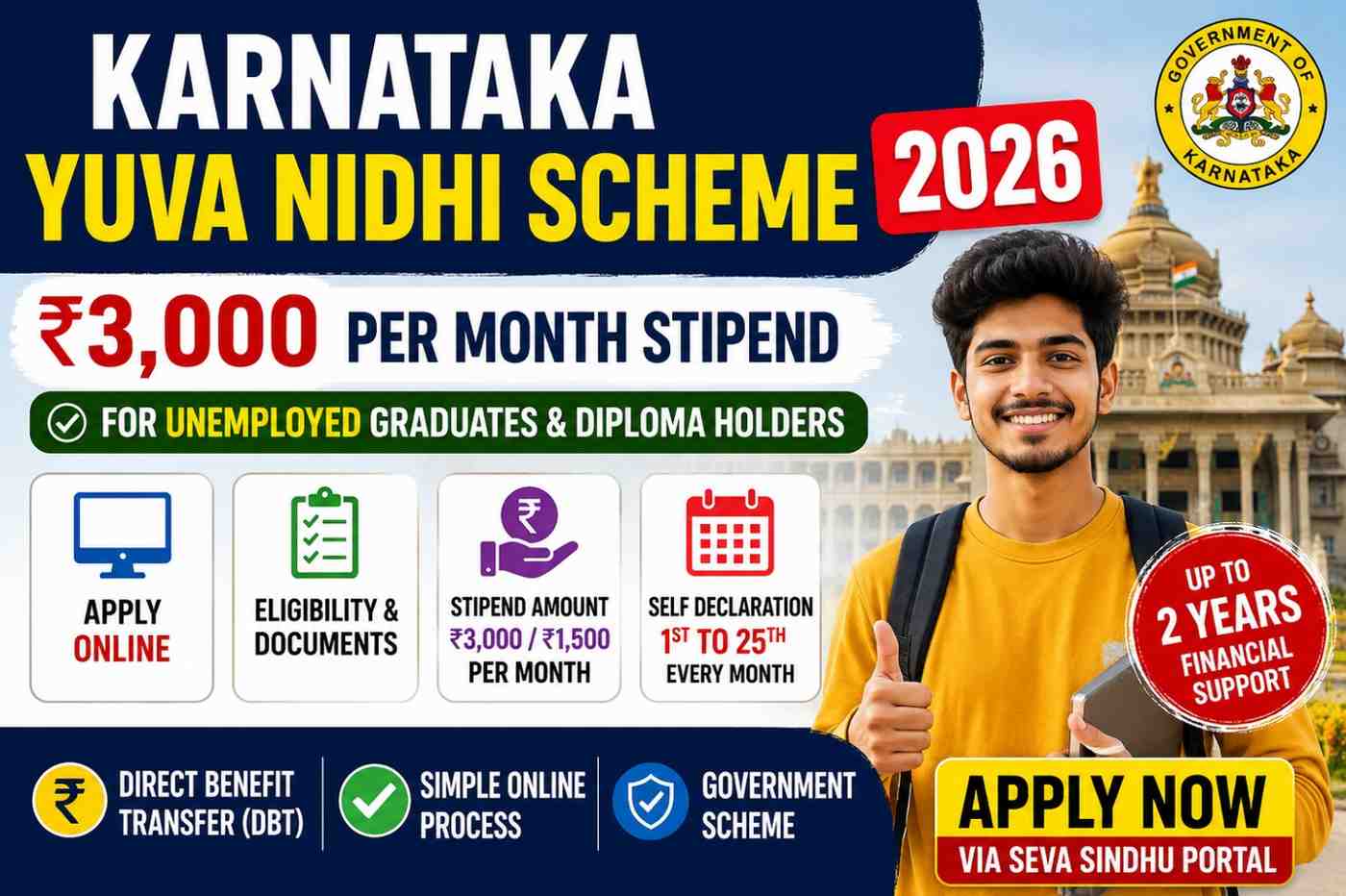
Latest Update (June 2026): Eligible unemployed graduates and diploma holders can continue applying for the Karnataka Yuva Nidhi Scheme through the Seva Sindhu portal. Beneficiaries must submit their monthly self-declaration between the 1st and 25th of every month to continue receiving DBT benefits.
The Karnataka Yuva Nidhi Scheme 2026 is a flagship welfare initiative launched by the Government of Karnataka under the Skill Development, Entrepreneurship, and Livelihood Department. Designed to act as a financial safety net for educated, unemployed youth across the state, the scheme provides a monthly unemployment allowance (stipend) to recent graduates and diploma holders.
Eligible candidates who have completed their degree or diploma but have not yet secured employment are entitled to receive up to ₹3,000 per month. This comprehensive guide covers all essential details, including the strict eligibility criteria, required documents, the step-by-step online application process, and the mandatory monthly self-declaration procedure required to keep the Direct Benefit Transfer (DBT) active.
Karnataka Yuva Nidhi Scheme 2026: Brief Overview
Also check: Karnataka SC Prize Money Scholarship 2026: Apply Online, Eligibility & Amount details
| Organization Name | Government of Karnataka |
| Scheme Name | Yuva Nidhi Scheme (ಯುವ ನಿಧಿ ಯೋಜನೆ) |
| Administered By | Skill Development Entrepreneurship & Livelihood Department |
| Target Beneficiaries | Unemployed Graduates & Diploma Holders of Karnataka |
| Assistance Amount | Degree: ₹3,000/month | Diploma: ₹1,500/month |
| Maximum Duration | 2 Years (24 Months) |
| Application Mode | Online via Seva Sindhu Portal |
| Self-Declaration | Mandatory between the 1st and 25th of every month |
| Official Website | sevasindhuservices.karnataka.gov.in |
What is Karnataka Yuva Nidhi Scheme
The Yuva Nidhi Scheme is one of the flagship guarantee schemes launched by the Government of Karnataka. It is designed specifically to act as a financial safety net for young graduates and diploma holders who are struggling to find employment after completing their education. By providing a fixed monthly allowance, the government aims to help candidates manage their daily expenses, travel costs for interviews, and upskilling needs while they actively search for a job.
Yuva Nidhi Stipend Amount 2026
The financial assistance provided under the scheme is strictly categorized based on the applicant’s highest educational qualification:
- For Graduates: Candidates who have completed a Degree (B.A., B.Sc, B.Com, B.E, B.Tech, etc.) will receive ₹3,000 per month.
- For Diploma Holders: Candidates who have completed a recognized Diploma course will receive ₹1,500 per month.
Note: This amount is disbursed for a maximum of 2 years (24 months) or until the beneficiary secures employment—whichever comes first.
Important DBT Rule: The allowance is not triggered immediately upon graduation. The DBT process is initiated strictly after the completion of 180 days from the official “Date of Result” printed on the applicant’s final marks card. Furthermore, the beneficiary’s bank account must be actively seeded with their Aadhaar number (NPCI mapped) to receive the funds.
Yuva Nidhi Scheme Eligibility Criteria 2026
To successfully register for the Yuva Nidhi Scheme, applicants must fulfill all the following academic and residential requirements:
- Domicile Requirement: The applicant must be a permanent, verified resident of Karnataka. They should have completed a minimum of six years of education within the state.
- Academic Window: Candidates who have completed eligible degree or diploma courses within the period notified by the Government of Karnataka and satisfy the unemployment criteria may apply
- Unemployment Gap: The applicant must remain continuously unemployed for a minimum period of 180 days (approximately six months) immediately following the declaration of their final results.
- Bank Seeding: The applicant must possess an active bank account linked to their Aadhaar card for DBT compatibility.
Also Check Out: Karnataka SC/ST Hostel Admission 2026-27: Apply Online for Free SWD Hostels
Who is Not Eligible for Yuva Nidhi Scheme
The government will automatically reject applications from candidates who fall into the following categories:
- Individuals currently pursuing full-time higher education (e.g., Master’s degree, Ph.D.).
- Candidates employed in any formal government or private sector job (verified via active PF/ESI accounts).
- Self-employed youth who have already secured business loans under other state or central government schemes.
- Individuals currently receiving an apprentice salary or benefiting from other state unemployment programs.
NAD Verification and Its Importance
The National Academic Depository (NAD) is a 24×7 online digital storehouse of all academic awards (certificates, diplomas, degrees, mark sheets) lodged by academic institutions and boards across India. It is integrated directly with DigiLocker to ensure secure, paperless verification of educational records.
Why is NAD critical for the Yuva Nidhi Scheme? For the Yuva Nidhi scheme, the Seva Sindhu application portal is directly linked to the Karnataka NAD database. When you enter your University Registration Number or USN to apply, the system queries the NAD portal to instantly verify your graduation status and your exact passing year.
- The Mandatory Rule: You cannot submit a Yuva Nidhi application unless your college or university has officially uploaded your final degree/diploma data to the NAD portal.
- How to Check Your NAD Status: Before starting your application on Seva Sindhu, visit the official Karnataka NAD portal (
nad.karnataka.gov.in). You can use the “Yuva Nidhi Eligibility Check” feature on the homepage. Enter your university name and registration number, and the system will instantly inform you if your academic records are available. If they are missing, you must request your university administration to push your data to NAD
Documents Required for Yuva Nidhi Application Online
Candidates must prepare digital copies of the following documents before initiating the online registration process on the Seva Sindhu portal:
- Aadhaar Card (Linked with the current mobile number for OTP authentication).
- SSLC & PUC Marks Cards (For basic identity and education verification).
- Degree or Diploma Certificate (Final Marks Card or Provisional Degree Certificate indicating the exact date of result).
- Domicile / Residence Certificate (To prove Karnataka residency).
- Income Certificate Income certificate may be requested during verification depending on department requirements.
- Unemployment Self-Declaration Form (Digital consent provided during the application).
- Mobile Number And e-mail Id.
Watch: Yuva Nidhi Scheme 2026 Online Application Video Guide
Candidates who need help with the online application process can watch the step-by-step Yuva Nidhi application video tutorial below. The video explains registration, Aadhaar authentication, document upload, self-declaration, and status checking.
Karnataka Yuva Nidhi Scheme 2026 Online Application Video
How to Apply Online for Karnataka Yuva Nidhi Scheme
Follow these step-by-step instructions to submit a new application:
- Access the Portal: Open your web browser and navigate to the official Seva Sindhu Services website (sevasindhuservices.karnataka.gov.in).
- User Registration/Login: If you are a new user, click on “Register Here” to create a ServicePlus account using your Aadhaar number. Existing users can log in using their registered mobile number and OTP.
- Locate the Scheme: Navigate to the ‘Apply for Services’ section and click ‘View All Available Services’. Search for “Yuva Nidhi Scheme”.
- Aadhaar Authentication: Click on the application link and complete the e-KYC process by entering your Aadhaar number and submitting the OTP.
- Enter Academic Details: Input your University Registration Number (or UUCMS number for state universities). The system will attempt to fetch your academic records automatically.
- Upload Documents: Fill in the remaining personal details and upload clear, scanned copies of all required documents.
- Submit & Acknowledge: Review the application, accept the declaration, and click Submit. Download and save the generated Application Reference Number (e.g., IE009S…) for future status tracking.
How to Submit Monthly Self Declaration 2026
To ensure that only actively unemployed youth receive the stipend, the Government of Karnataka has mandated a monthly self-declaration process. If a beneficiary fails to submit this declaration, their DBT for that specific month will be paused.
- Timeline: The self-declaration must be submitted between the 1st and 25th of every month.
- Submission Process:
- Log in to the Seva Sindhu portal.
- Search for the “Yuva Nidhi Self Declaration Form” (under the Department of Industrial Training and Employment).
- Click on “Get Aadhaar Details” and authenticate via OTP.
- The system will pre-fill your reference number and current month.
- Accept the consent form stating you have not secured employment, enter the captcha, and click Submit.
- Download the monthly acknowledgment receipt.
- If you fail to submit this declaration, the government will assume you have found a job, and your allowance (DBT) for that month will be permanently stopped.
How to Check Yuva Nidhi Application Status Online
Applicants can easily track their Yuva Nidhi application status through the Seva Sindhu portal by following the steps below:
- Visit the official Seva Sindhu Services portal.
- Log in using your registered mobile number and OTP.
- Click on “Track Application Status” or “Application Status”.
- Enter your Application Reference Number (generated during registration).
- Complete the verification process if prompted.
- Click Submit to view the current status of your application.
- The portal will display statuses such as:
- Submitted – Application successfully submitted.
- Under Verification – Documents and eligibility are being verified.
- Pending with DEEO/DDPI – Awaiting approval from the concerned district authority.
- Approved – Application approved and eligible for DBT processing.
- Rejected – Application rejected due to eligibility or document issues.
- DBT Processed – Payment has been processed and sent through NPCI.
- DBT Credited – Amount successfully credited to the beneficiary’s bank account.
What to Do If Status Is Pending?
- If your application remains Pending with DEEO/DDPI for more than 30 days, visit the concerned office with your original documents.
- If the status shows DBT Processed but money is not credited, check your Aadhaar-NPCI bank mapping status with your bank branch.
- Ensure your monthly self-declaration is submitted between the 1st and 25th of every month to avoid payment interruptions.
Pro Tip: Save your Application Reference Number safely, as it is required for checking status, submitting grievances, and tracking DBT payments.
Yuvanidhi Common Errors & Status Solutions
Applicants often face technical hurdles during the application or verification stages. Here are the official solutions to the most frequent issues:
- UUCMS Data Not Fetching Error
Students from state universities often find that their registration numbers do not pull data from the UUCMS portal.
This occurs when the respective university has not yet updated the final graduation data on the central UUCMS server. You must wait for the university to push the data, or you can visit your district’s education office to inquire about manual data entry.
- Domicile Verification Pending by DEEO / DDPI
If your application status is stuck on this message for several weeks, the automated verification has failed.
You must physically visit your District Employment Exchange Office (DEEO) or Deputy Director of Public Instruction (DDPI) office. Carry your original physical mark sheets, Aadhaar card, and application acknowledgment for manual verification. Approval typically reflects online within 30 days of the physical visit
- Aadhaar OTP Delays
Network congestion can delay the mandatory Aadhaar OTP required for e-KYC verification.
- DBT Not Credited After Approval
Your application is approved, but the money has not arrived.
Check the date of your final result. The DBT will strictly begin processing only after 180 days have passed since that exact date. Secondly, verify your NPCI mapping status with your bank branch to ensure your account is authorized to receive government DBT funds.
- The Higher Education Pursuing Problem
One of the most common issues applicants face relates to pursuing further studies. The Yuva Nidhi scheme has strict rules regarding the academic status of the beneficiary.
Many students apply for the Yuva Nidhi scheme after completing their graduation (like B.A. or B.Com) and simultaneously enroll in a Master’s degree (like M.A., MBA, or B.Ed) or any other higher education course (regular or distance). When the verification department (DEEO/DDPI) cross-checks their data or when they attempt to do their monthly self-declaration, their application gets blocked or rejected.
The Yuva Nidhi scheme is exclusively for youth who have completed their education and are actively seeking employment. Anyone who is currently enrolled in higher education is strictly disqualified from receiving the allowance.
- If you have already joined higher education: You must log into the Seva Sindhu portal and officially update your status to “Pursuing Higher Education.” This will voluntarily stop your DBT. If you hide this information and continue receiving the money, the government can initiate legal recovery of the disbursed funds once the data is audited through the university databases.
- If you plan to join later: You can receive the Yuva Nidhi allowance only until the month before your official admission date into a higher education program. Once admitted, you must stop your self-declaration.
- DBT Processed but Amount Not Received Problem
It is highly frustrating for applicants when they check their Yuva Nidhi status on the Seva Sindhu portal and see the message “DBT Processed”, but when they check their bank balance, no money has been credited.
“DBT Processed” means that the Karnataka Government’s Treasury Department has officially approved your payment and successfully pushed the funds into the National Payments Corporation of India (NPCI) gateway. If the money hasn’t reached you, the problem is almost always sitting with your specific bank branch.
Core Reasons Why This Happens:
- Aadhaar/NPCI Un-mapping: Your bank account is linked to your Aadhaar card for normal transactions, but it is not mapped to the NPCI server to receive government Direct Benefit Transfer (DBT) funds.
- Account Limits/Freezes: You might be using a basic savings account (like a Jan Dhan account or a student account) that has a strict receiving limit, or the account is temporarily frozen because you haven’t updated your KYC (Know Your Customer) documents recently.
- The 180-Day Rule Delay: Sometimes the portal approves the application, but the actual treasury release is hard-coded to wait until exactly 180 days (6 months) have passed since the result date printed on your final degree/diploma certificate.
The Solution
- Step 1: Do not wait for the Seva Sindhu portal to fix this, as the money has already left the government’s hands.
- Step 2: Take a physical copy of your Aadhaar card, PAN card, and a passport-size photo and immediately visit your “Home Branch” (the specific bank branch where you opened the account).
- Step 3: Ask the bank manager to check your “DBT / NPCI Mapping Status.” * Step 4: If it is inactive, ask for an NPCI Mapping Mandate Form. Fill it out, submit your KYC documents, and ensure they link it on the same day.
- Once the bank clears the block, the pending “Processed” amount will automatically bounce back into your account within 3 to 7 working days.
You can seamlessly plug these sections right into the “Common Problems” area of your article. Your post is going to be incredibly comprehensive, Sathi! Let me know if you need me to format any other sections for you.
What Happens After Yuva Nidhi Application Approval
Once submitted, your application goes through a multi-stage verification process:
- System Verification: The portal cross-checks your Aadhaar, EPF/ESI status, and educational records.
- Department Approval: The District Employment Exchange Office (DEEO) or Deputy Director of Public Instruction (DDPI) reviews your domicile and academic gap.
- Approval Status: Once approved, you will receive an SMS confirmation, and your DBT cycle will be scheduled.
How the Amount Credit Process Works
The Karnataka Government relies entirely on the Direct Benefit Transfer (DBT) system.
- Once your self-declaration is approved for the month, the treasury generates a payment order.
- The funds are routed through the NPCI (National Payments Corporation of India) gateway.
- The money is automatically credited to the specific bank account that is currently seeded with your Aadhaar number.
The Real Problem After Application
Beyond the initial registration, the actual challenges beneficiaries face include:
- Pending Verification: Applications often stay stuck at “Pending with DEEO/DDPI” for months. Candidates are forced to physically visit their district offices with original documents to push the approval through.
- DBT Failures: Even after approval, payments fail if the beneficiary’s bank account has a limit cap, is frozen due to lack of KYC, or is unmapped from NPCI.
- Delayed Releases: Monthly payments are rarely credited on a fixed date. For example, the December allowance is often delayed and credited in late January or February due to budget processing times.
Yuvanidhi Important Dates
- Scheme Launch Date: December 2023
- Eligibility Period: As notified by the Government of Karnataka from time to time.
- Monthly Self-Declaration Window: 1st to 25th of every month in 2026
Yuva Nidhi Important Notes
- Always ensure your mobile number remains linked to both your Aadhaar and your Bank Account.
- If you secure employment at any point during the 24 months, you are legally obligated to update your status on the portal to stop the allowance.
- Never pay any broker or third party to approve your Yuva Nidhi application; the process is entirely free and online.
Yuva Nidhi Helpline Number
- Help line number : 18005997150
Karnataka Yuvanidhi Important Links
| Important Links | Click Here |
| Apply Online / Login Portal | Click Here |
| Submit Monthly Self-Declaration | Click Here |
| Check Yuva Nidhi Application Status | Click Here |
Karnataka Yuva Nidhi FAQs 2026
What is the last date to apply for the Yuva Nidhi Scheme in 2026?
Ans: There is no strict last date to apply. Candidates who meet the 180-day unemployment gap criteria for the 2022-23 and 2023-24 academic years can apply on a rolling basis.
Can I submit the monthly self-declaration offline?
Ans: No. The self-declaration must be submitted strictly online through the Seva Sindhu portal between the 1st and 25th of every month.
Why is my Seva Sindhu application showing “UUCMS Data Not Found”?
Ans: This error occurs when your respective university has not synchronized your final graduation results with the central government server. You must wait for your university to update the database.
Will I receive the amount immediately after graduation?
Ans: No. You must wait exactly 180 days (6 months) from the “Date of Result” printed on your final marks card before you become eligible for the scheme.
What should I do if my application is stuck at “Pending with DEEO”?
Ans: If your status is pending for more than 30 days, you should visit your District Employment Exchange Office (DEEO) with your original marks cards and Aadhaar for manual verification.
Can students pursuing post-graduation apply for Yuva Nidhi?
Ans: No. The scheme strictly prohibits students who are enrolled in full-time or distance higher education (like MA, M.Sc, M.Com, MBA) from receiving the allowance.
Is there any family income limit for the Yuva Nidhi Scheme?
Ans: Unlike other government schemes, the primary criteria are educational qualification and unemployment status. However, standard income certificate verification is often conducted to rule out highly affluent households.
Why was my Yuva Nidhi payment approved but not credited to my bank?
Ans: This is almost always a bank-side issue. Your bank account must be “Aadhaar Seeded” and “NPCI Mapped.” Visit your home branch and submit an NPCI mapping form.
Can I change my bank account after applying?
Ans: You do not need to manually change it on Seva Sindhu. The DBT system automatically sends the money to whichever bank account is currently seeded with your Aadhaar at the NPCI level.
How long will the scheme provide the monthly allowance?
Ans: The allowance is provided for a maximum limit of 24 months (2 years). If you find a job before the 2 years are up, the payments will cease automatically.
What is the official website to submit the Yuva Nidhi monthly self-declaration?
Ans: The self-declaration must be submitted exclusively through the official Seva Sindhu Services portal (sevasindhuservices.karnataka.gov.in).
What is Yuva Nidhi Help Line Number?
Ans: You can raise a grievance by contacting the official Karnataka Guarantee Schemes helpline at 18005997154
How can I check whether my bank account is NPCI mapped for Yuva Nidhi?
Ans: Visit your bank branch or use your bank’s customer service to verify Aadhaar-NPCI mapping status. Only NPCI-mapped accounts can receive Yuva Nidhi DBT payments.